
Introduction
Chiron is the name of a centaur from Greek myth, a half-man, half-horse being. Most centaurs are wild, lustful, uncivilized, and untamed, living in nature and only occasionally making an appearance. But Chiron is different: he was a wise, skilled, and well-mannered centaur. Most centaurs had a human father, but Chiron’s origin was divine. He was conceived by the union of the Titan Kronos with the nymph Philyra. As a result, his role models and teachers were divine, and he himself became a teacher to the gods.
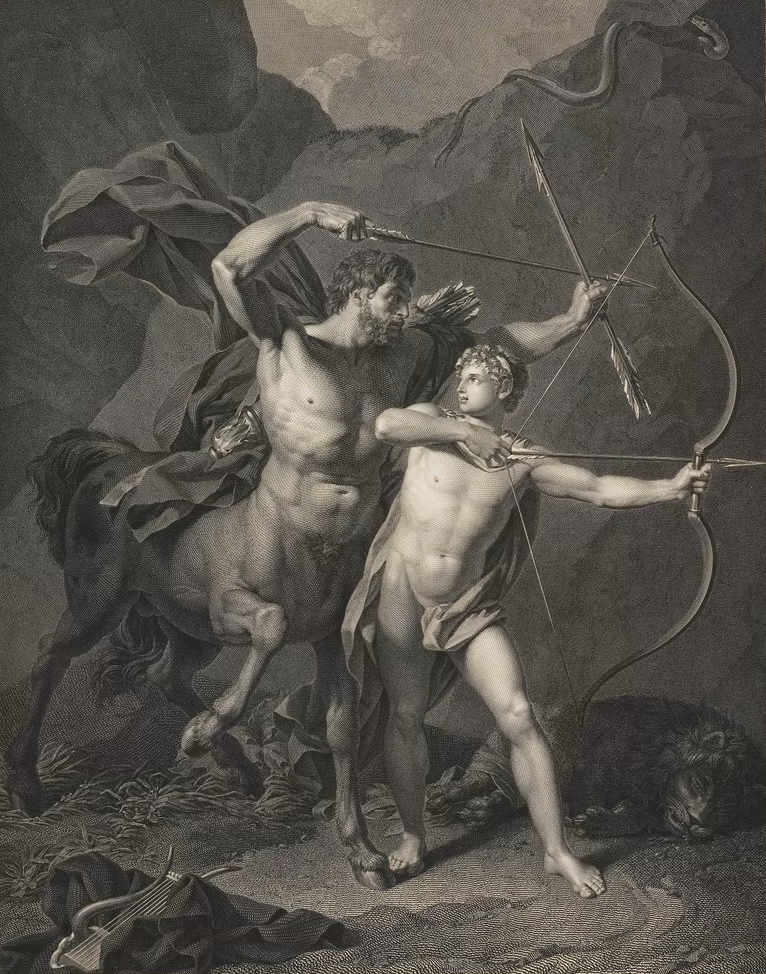
One of the first life experiences that Chiron had was to be rejected by his mother, the nymph Philyra. She is said to have found Chiron horrifying because he was half man, half horse, and she turned into a linden tree to escape him. His mother judged him by form and abandoned him. His father, Kronos, was also completely absent. The gods, on the other hand, judged Chiron by his essence and recognized something special in him. Apollo taught Chiron music, prophecy, and healing, and Artemis taught him hunting and archery.
During a battle that broke out between Heracles and the other centaurs, the myth tells us that Chiron was accidentally hurt by a poisoned arrow, which wounded him permanently. Since he had a divine origin, Chiron was immortal, but the wound from the poisoned arrow could not be cured, even though he was a skilled healer himself. Chiron spent the rest of his life in constant pain, becoming the symbol of the wounded healer.
Chiron decided to sacrifice his immortality to Zeus in exchange for Prometheus’s freedom. Prometheus was also immortal, and he was punished by the gods for giving fire to humanity. He was chained to a rock, and an eagle ate his liver every day, which would regenerate only to be eaten again the next day. Zeus accepted Chiron’s sacrifice, took away his immortality, and freed Prometheus. Chiron was honored by being placed in the sky as the constellation of the Centaur or Sagittarius.
In Astronomy
This is a short retelling of the myth of Chiron, introduced here to help us understand Chiron in astrology. However, before that, we should mention some astronomical details about Chiron.

In astronomy and astrology, Chiron is a celestial body with an orbit between Saturn and Uranus. We don’t have a very clear idea why the astronomer who discovered Chiron in October 1977 named him so, but he must have been familiar with the myth of Chiron.
It’s quite interesting that Charles Kowal, the person who discovered Chiron, gave it this name. Based on Chiron’s orbit, we see that it travels slightly outside the orbit of Saturn and slightly inside that of Uranus, linking these two planets. In astrology, Uranus is often linked to Prometheus, and Saturn to Kronos. Chiron’s life began with Kronos and ended with Prometheus in a symbolic way.
Chiron is one of the many invisible bodies in our solar system. We can’t see it with the naked eye, and even with instruments it has not been easy to spot, which is why it was discovered so late. 2060 Chiron, as it is known in astronomy, was first thought to be a small planet, then classified as an asteroid, and later as a comet because astronomers discovered a coma and gas emissions. Finally, it was classified as a centaur — a small, icy body showing both cometary and asteroidal characteristics. It is interesting how, for many years after its discovery, astronomers found it difficult to classify this body because it was so different from the ones we knew about. There are other centaurs in myth and astronomy (Pholus, for example), but they are a subject for future research.
Chiron is thought to have an unstable orbit, so it will not always remain in our solar system. Its orbit might turn it into a periodic comet, or it might leave the solar system completely. But for the next few million years, Chiron is here to stay.
In Astrology
In astrology, Chiron is not well understood. Many professional astrologers reject it and leave it out completely from their interpretations. This is particularly interesting given the myth of the centaur who was rejected after birth by his own mother.
There are valid reasons to include or exclude Chiron from a chart interpretation. It is not bad astrology to leave it out, but it does add more detail and nuance to your interpretation if you understand this body. Many elements in astrology — such as fixed stars, asteroids, and centaurs — provide very specific details in interpretation, but the bulk of a chart will always concern the seven traditional planets, which include the two luminaries. That is why many astrologers can ignore these concepts for years and still achieve remarkable results.
Chiron has a highly eccentric orbit, so it spends around seven to eight years in Pisces and Aries, and only one to two years in Virgo and Libra. The orbit that comes closest to being a perfect circle is that of Venus, the planet that rules balance and harmony. Chiron also does not rule any sign; only the two luminaries and the five visible planets are assigned sign rulerships.
To understand a celestial body in astrology, I like to compile words that evoke its energy. Reading a list of words describing a planet can help you immerse your mind in its energy. I put together such a list for Chiron to better understand its meaning in astrology. This is based on research done by astrologers so far, as well as my own observations of Chiron in practice.
The wounded, rejection, abandonment, exile; the outcast, the scapegoat, disability, paralysis, chronic illness, chronic pain, pain without remedy; the teacher, the healer, the mentor of heroes, the wise; sacrifice, renunciation, surrender, acceptance, selflessness; the bridge between the limited and the unlimited; the gift of suffering, compassion, service; the incurable disease, the demand for meaning; loss of the will to live, the feeling of being inadequate, worthless; feeling hollow, incomplete, meaningless; being off-centre, malformed, distorted, disfigured; voluntary sacrifice; the outsider, the misfit; the feeling of inferiority, feeling you do not have the right to exist, being invalidated, alienated, ineffective; the inner teacher, the advocate, the guide.
The Chiron Effect
If you want to deduce what Chiron — or any celestial body — means in astrology, the easiest way is to find a good sample of accurately timed natal charts and study the biographical details of the people in question.
We want Chiron to be prominent in these charts. The most sensitive areas where Chiron can have the most noticeable effect are when it is in close conjunction or opposition with:
- the Ascendant or its ruler
- the Sun in a day chart or the Moon in a night chart
- the Midheaven
I selected a few people to illustrate how this archetype in our psyche can manifest in life. I focused only on individuals whose Ascendant was in an applying conjunction with Chiron. This means that within a few minutes of their birth, Chiron rose over the eastern horizon.
Rachel Miner
She is the first person I came across whose life story and chart made the link to Chiron very clear. According to Rachel, she was diagnosed with multiple sclerosis about a week after her 30th birthday, though she mentioned she had felt something was wrong about a year and a half before that.
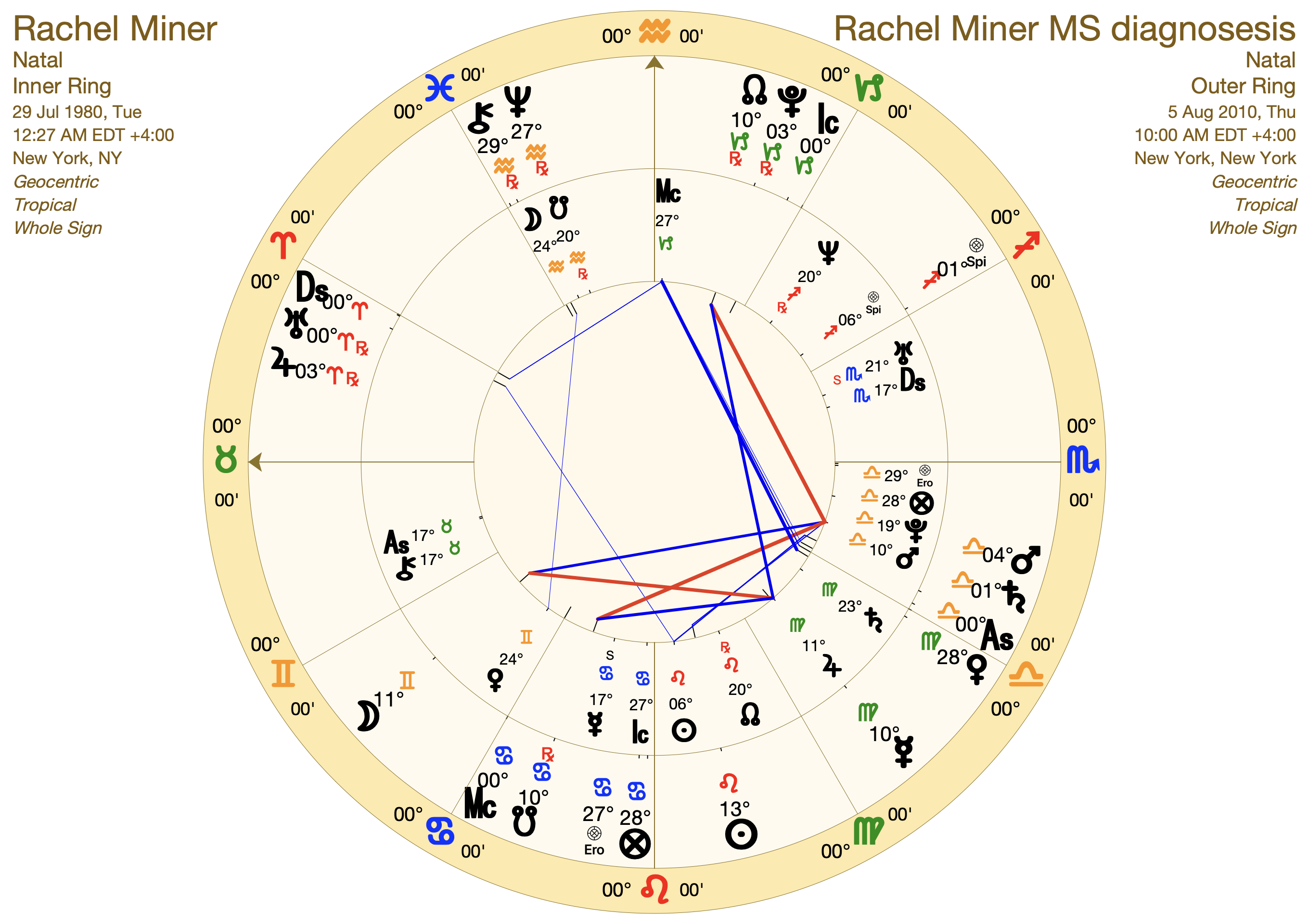
If we look at her chart, we see some classic indicators of health trouble. For health matters, astrologers usually examine the Ascendant, the sixth house, and the Moon. Rachel had a Mars–Saturn conjunction in a night chart, placed in the sixth house of bodily health. She said she had mobility issues, fatigue, and cognitive effects. These are all consistent with Saturn in the sixth house — the planet is often associated with slowness, dullness, and weakness. Muscle weakness and fatigue are also associated with multiple sclerosis, and they are keywords for Saturn as well. Even without Chiron, we could easily predict this would be a very challenging period in her life.
Her cognitive issues can be correlated with the natal Moon in Aquarius in the tenth house, which is ruled by Saturn. That Moon is also in a very tight conjunction with Chiron and Neptune. Even just considering Neptune, this period could be interpreted as one of mental confusion or brain fog, with difficulty in memory and recall. In astrology, the Moon is associated with the mind and memory, as well as with the physical body.
Now, you are probably wondering what additional information Chiron provides and how it helps the chart interpretation. The Saturn transit passed, and the Chiron and Neptune transits over her Moon did as well. However, multiple sclerosis is a chronic, incurable disease. This is the part we can easily associate with Chiron. Much like the wounded centaur, there is nothing Rachel can do to improve her condition.
We live in a time when many people believe that anything is possible if you truly want it to change. Rachel Miner’s life is a reminder that difficult things happen which can affect you permanently. There is no escape and no full recovery; all you can do is accept things as they are. Surrendering to what is — accepting what you cannot change — is a difficult task. To face the life area where Chiron is active for you, you likely need wisdom and continual acceptance. Acceptance does not happen instantly; you cannot decide to accept and expect everything to be fine afterward. There will be difficult and painful moments when you must remind yourself again and again that acceptance is the only key to finding some freedom in your situation.
Rachel’s life became very limited. She talked about how she can no longer act in roles she would love because she can’t be as physically active, but she also spoke about learning to live in the present moment and becoming an advocate for actors with disabilities. In her chart, there is also a very tight conjunction between Chiron and Mercury, which suggests she is well suited and talented at speaking about her experience with Chiron — living with an incurable disease.
Gretchen Whitmer
Not all Chiron stories are associated with physical disabilities. They can also involve experiences that create invisible wounds, which are just as difficult — and sometimes impossible — to fully overcome. We can see this in the case of Gretchen Whitmer, the governor of Michigan.
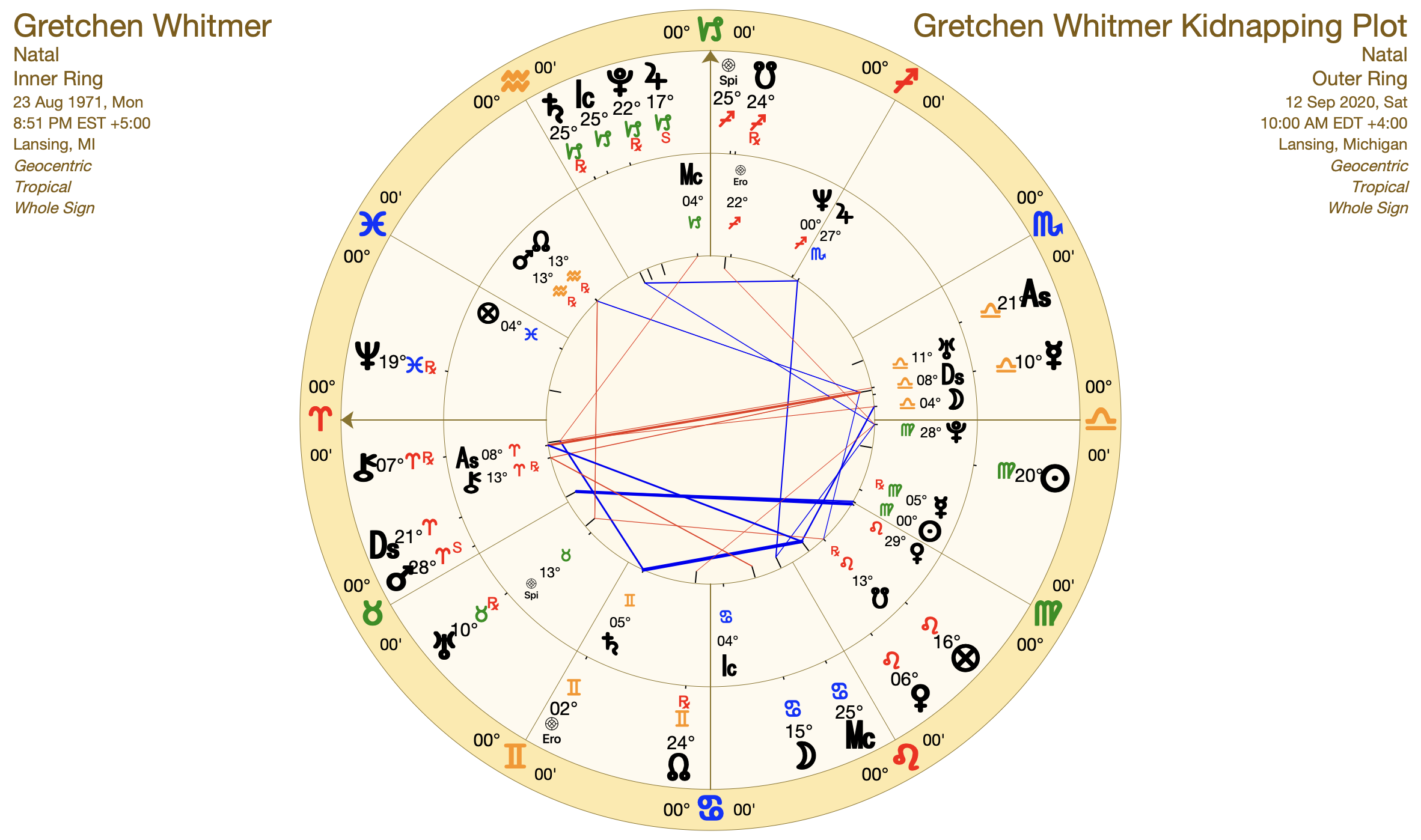
Gretchen experienced several very difficult events, two of the most notable being the assault she suffered from a male student while at university and the challenges she faced during the pandemic in 2020–2021. She described the assault as deeply painful but said she was grateful it did not result in a pregnancy. During the pandemic, she imposed very strict lockdowns as governor of Michigan, which led to protests outside her home and even a plot to kidnap and assassinate her. She was ultimately saved by the authorities. Gretchen described these experiences as leaving a hollow space within her, which she filled with purpose. This is a common theme for people experiencing Chiron transits over the Ascendant or the luminaries.
If you did not interpret Chiron but Gretchen came to you for a consultation, you would immediately see that the Saturn transit through the tenth house, along with the Mars, Jupiter, and Pluto conjunctions, would mark an extremely difficult time. Pluto is often associated with Hades, who in mythology kidnapped Persephone. In astrology, Pluto is also linked with hidden plots, kidnappings, rape, and power struggles. Saturn represents strict measures, which she likely had to enforce in her professional role. The tenth house governs one’s career; Saturn shows the capacity to create strict rules, and Pluto takes everything to an extreme. Gretchen became known for imposing some of the strictest lockdowns and restrictions in the United States.
She also has Aries rising with a Mars–North Node conjunction, which fits her personality. She is a fighter who never runs out of energy. Aries rising individuals have an exceptional ability to rise and keep going through adversity. Mars, as the Ascendant ruler and conjunct the North Node, intensifies her assertiveness, motivation, and ambition. However, Mars–North Node aspects can sometimes appear in people whose Martian energy is turned inward. When Mars is not expressed outwardly in a healthy way — when anger is repressed — such individuals may encounter angry or violent people externally. Many of her natal and transit configurations together paint an accurate picture of Gretchen’s personality and the kinds of experiences she might face.
If I were consulting Gretchen, I would focus additionally on her feelings of hollowness or emptiness and her experience of being scapegoated. What is particularly interesting here is that her intention was to protect the people of Michigan, but because her policies were considered extreme, people accused her of being tyrannical and turned her into an enemy. This experience was very public, making it valuable for astrologers to study. It occurred during her Chiron return. With the square from Pluto and Saturn in the tenth house, we can see how the experience of being scapegoated came with paranoia (Pluto) and fear (Saturn) from the public (tenth house). This is a clear example of how astrological symbolism can mirror life experience.
Had she consulted an astrologer, good advice might have been to avoid extreme measures and restrictions due to the danger of being scapegoated and facing public backlash. As the tenth house (career and public life) looked highly challenging, an astrologer might have suggested focusing more on the opposite house from the tenth — the fourth house (home and family life).
Aisha Tyler
Aisha Tyler is an American actress and talk show host who has appeared in numerous TV shows and films. In her case, we are looking at someone who struggled with infertility. She was unable to have children but did not publicly disclose her exact diagnosis. However, we see the Chiron theme immediately in this incurable physical condition.
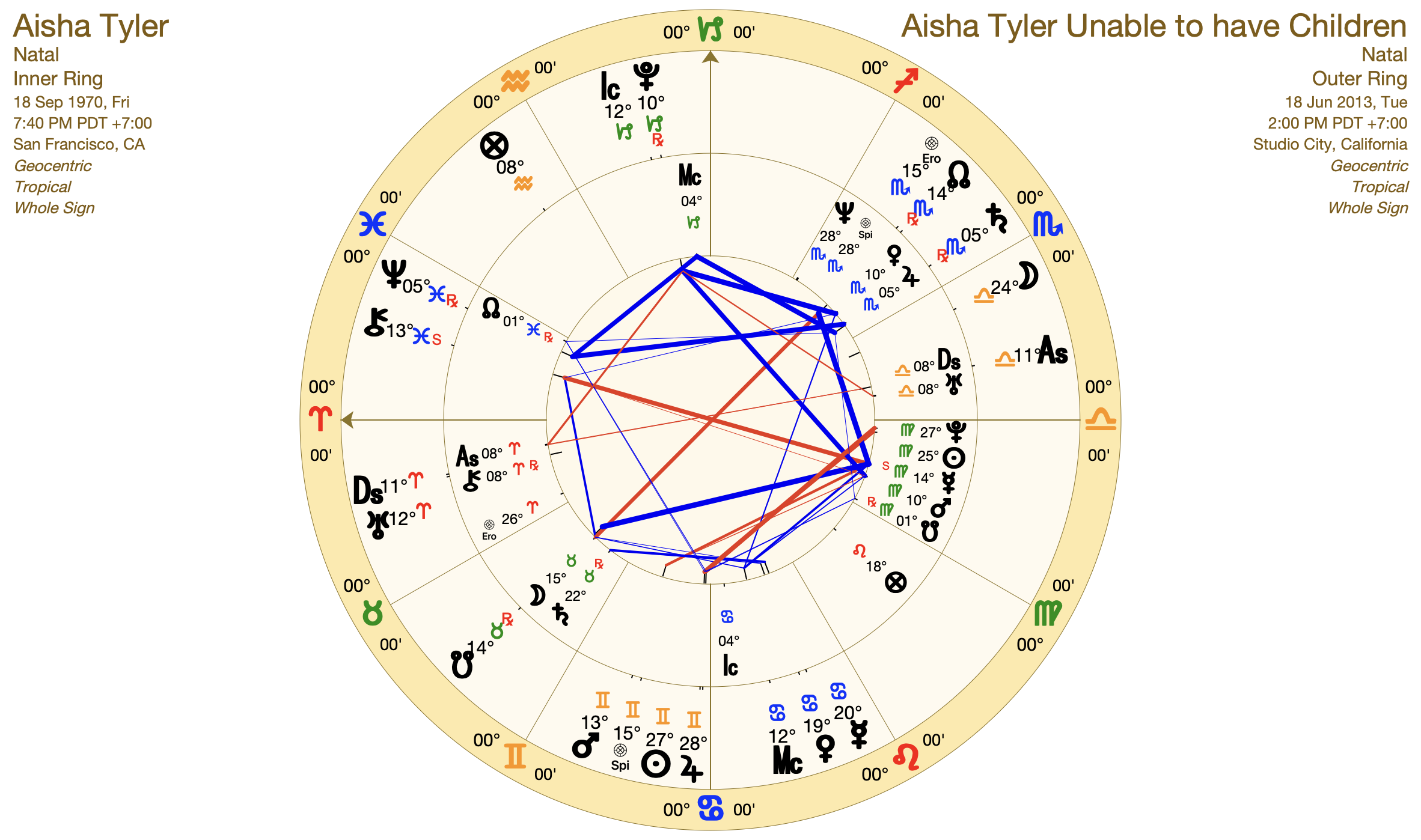
We again have Pluto involved. Her fifth house, which we usually examine to assess one’s ability to have children, is ruled by the Sun in the sixth house. The Sun forms a very close applying conjunction with Pluto. Besides taking things to an extreme, causing paranoia, and being associated with hidden plots or kidnappings, Pluto is also known for denying things. I’ve seen Pluto in my practice deny things completely, so part of the reason she did not have children could be related to her Pluto placement. There is something about the life area where Pluto lies in our chart that can be too terrifying to engage with. People may intuitively know that Pluto can take them through a crushing initiatory experience — a descent into the underworld. Many prefer to turn away from that life area entirely rather than engage with it, hence the complete denial.
However, her infertility — an irremediable inability to have biological children — echoes the Chiron symbolism. Aisha decided not to adopt children either, which also fits Pluto’s pattern of total denial or taking refusal to an extreme, bringing one to a breaking point. Another experience Aisha described, reminiscent of the myth of Chiron, was her attempt at various treatments and alternative solutions. She spoke about trying IVF and receiving injections that were painful and, as she said, “make your body crazy.” She decided to stop.
In an interview, she said that the door to having her own child was closed, but the door to adoption remained open. Yet she has chosen not to adopt. Several factors indicate her childlessness. First, infertility itself reflects Chiron. The Moon, though exalted in Taurus, is applying to a close conjunction with Saturn in a night chart. The Moon governs childbearing, childrearing, and maternal instincts in general, while Saturn — especially for those born at night — has a tendency to deny or limit. This, coupled with the Sun as ruler of the fifth house conjunct Pluto in the sixth house of “bad fortune,” are strong indicators.
If we look at the transits she experienced around the time she announced that having children would be impossible, we see Chiron in the twelfth house opposing all her sixth-house placements. Chiron especially opposed Mercury and the Sun, both of which signify children to some extent. The Sun represents youthful and creative energy and, as ruler of her fifth house, directly signifies children. Mercury, connected mythologically with the newborn Hermes, is also often associated with children. In astrology, when Mercury stations by secondary progression and other chart factors support it, this often coincides with a person’s first child. The South Node was also conjunct her natal Moon, symbolizing a period of letting go. Just a month earlier, when the Sun was in Taurus, she likely experienced eclipses over her natal Moon. Eclipses in that part of the chart suggest this was when she was trying to conceive and received the diagnosis that forced her to renounce her desire for children.
Whitney Houston
Whitney Houston was an American musician who needs no introduction. Everyone is familiar with her story. From what can be found about her, it appears she did not usually write her own songs but was celebrated for her profoundly moving interpretations. One example is I Will Always Love You, written by Dolly Parton, yet Whitney’s rendition had such an impact on the collective that it will likely forever be remembered as Whitney Houston’s song.
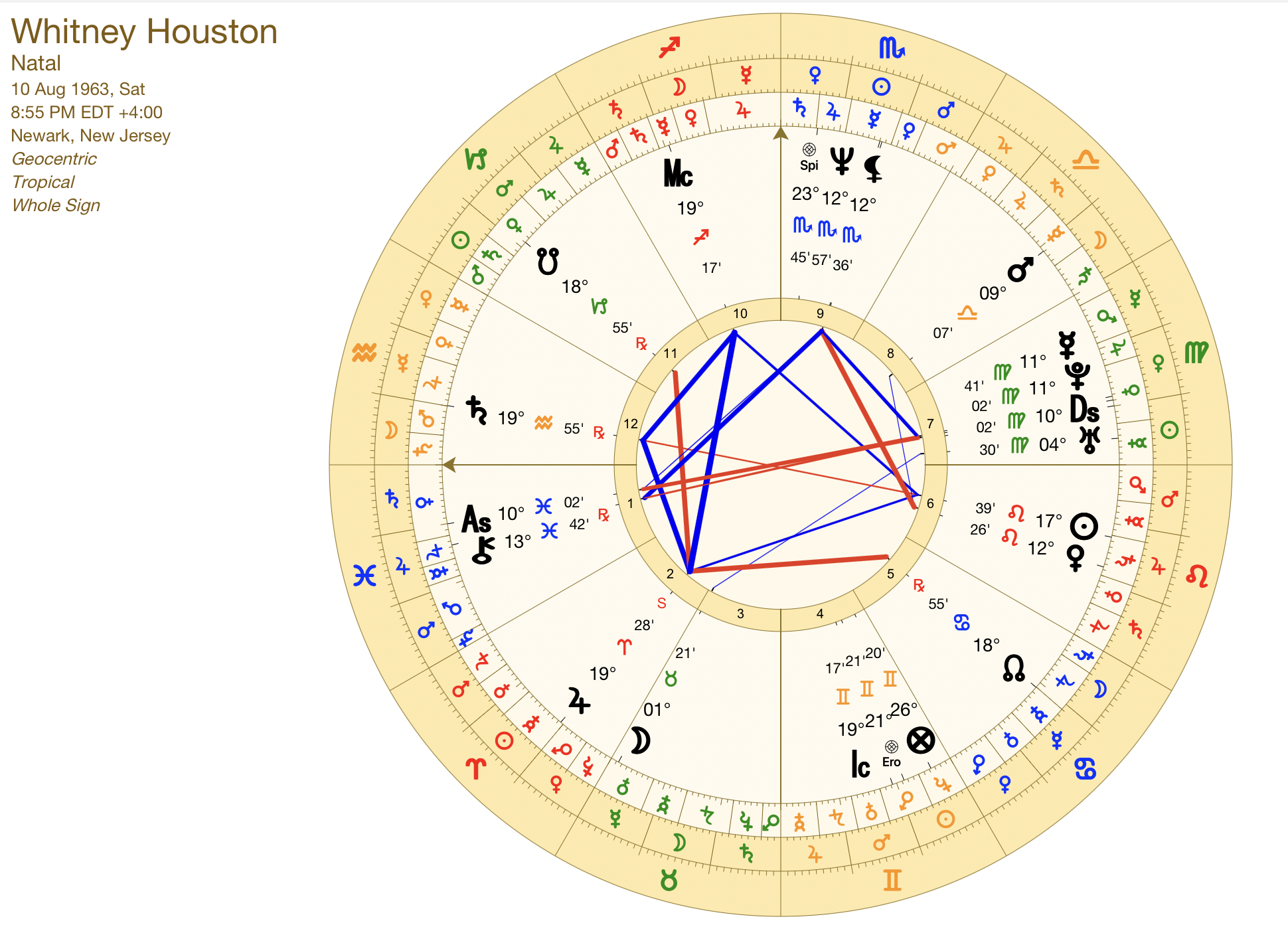
Whitney had Chiron in Pisces, very close to the Ascendant. This time we have a water sign — and a particularly complex one. All water signs relate in some way to emotional intelligence and emotional well-being. It is apparent from Whitney’s chart that she carried a deep emotional wound around her sense of self, personality, and identity.
There are a few publicly documented events from her life that could have been the root cause of this wounding. It was alleged that one of her female cousins sexually assaulted her during childhood. This allegation surfaced only in 2018, after Whitney’s death, so she never spoke publicly about it — if it was true at all. The issue is indeed very delicate. Victims of abuse often carry hidden stigma and shame for the rest of their lives, especially when the trauma remains unspoken.
Her first romantic relationship appears to have been with a woman named Robyn Crawford, with whom she later ended her physical relationship for one reason or another. Here, we again see a theme of rejection and abandonment. Her seventh house of relationships contains a very tight Mercury–Pluto conjunction. Pluto is often active when people reject something out of fear. There is sometimes a deeply unconscious motive behind a rejection or a “no.” We are usually too afraid to examine this motive directly, so we turn away from the areas Pluto touches. In Whitney’s case, it seems likely that she feared what would happen to her career if she had revealed her relationship with a woman. She chose to abandon her lover. If she was truly attracted to women, she not only abandoned her partner externally but also abandoned a part of herself internally.
There are many delicate questions here, which cannot be answered with astrology. For example: what did the alleged abuse during her childhood mean to Whitney, and what impact did it have on her psyche? Did she express romantic interest in women before that alleged abuse took place? Did the shame surrounding the abuse shape how she viewed queer relationships?
Whitney later entered a relationship with a man that became physically abusive, and by that time — perhaps to cope with the pain of existence — she had already turned to drugs. The story is tragic. It is not widely known that Whitney Houston may have had a female lover, if the accounts are true. From an astrological standpoint, however, it makes sense that one of the greatest struggles of her life was self-acceptance. With Chiron opposing all the planets she had in the seventh house, relationships and her sense of identity were in a state of profound tension. It is too late to know now, but had her problems been discussed more openly, things might have unfolded differently. Even without astrology, one could have seen that self-acceptance might have freed her from much pain and suffering.
Todd Haynes
Finally, we reach Chiron in an air sign with Todd Haynes. He is an American film director and screenwriter known for works such as Poison and Safe.
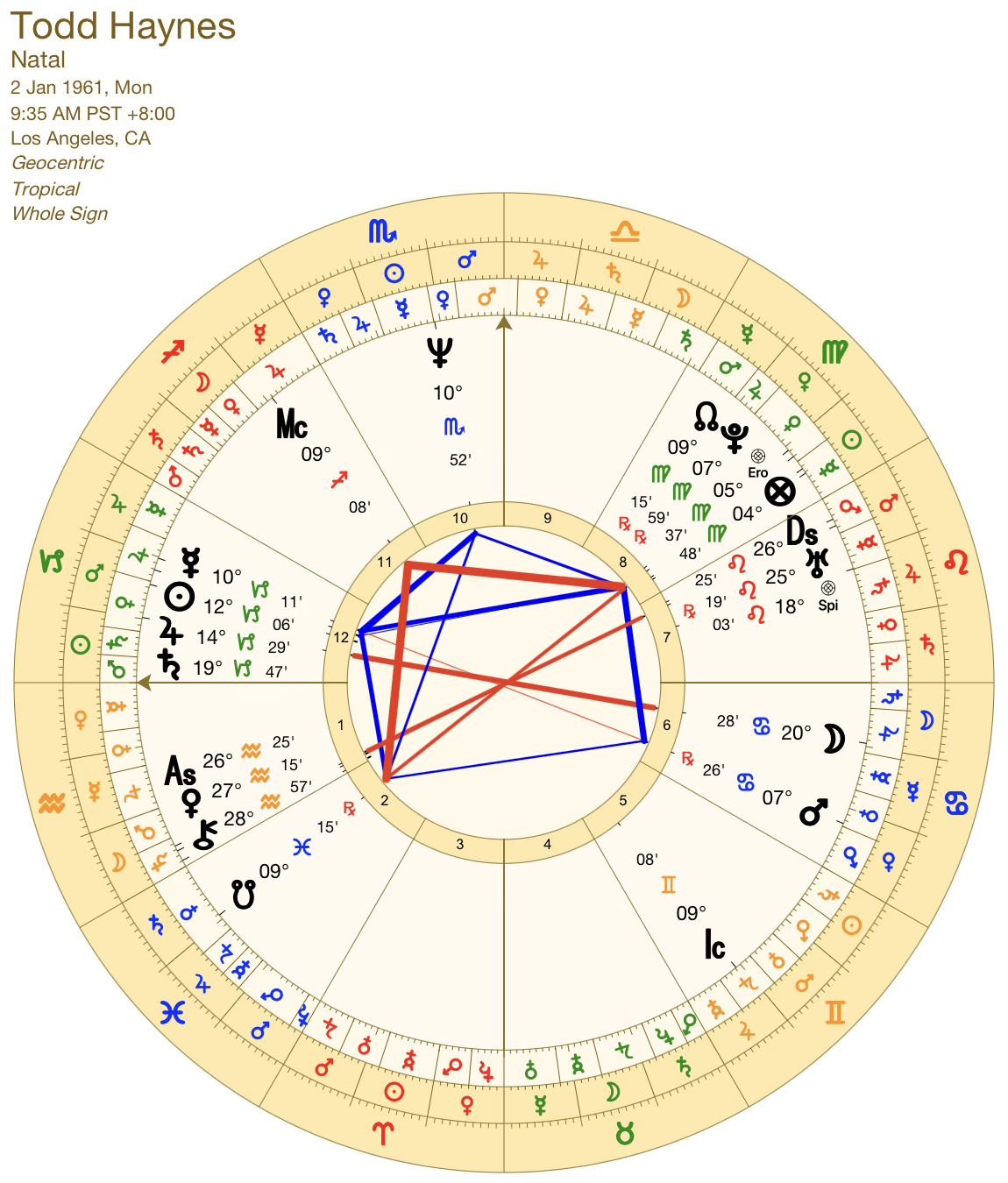
His example is especially interesting. His work and achievements relate to his Neptune in Scorpio in the tenth house, ruled by Mars in Cancer in the sixth house, forming a trine to Neptune. This combination connects world-building and illusion (Neptune) with themes of illness (sixth house). Both Poison and Safe serve as metaphors for the AIDS era. Planets in their sign of fall are often unpopular, and I have observed many examples where individuals express their planet-in-fall themes through their work. Such works are often seen as controversial, unsettling, or difficult to accept — something about them feels off or hard to digest.
The valuable insight we gain from Chiron in his chart is the native’s inclination to be scapegoated. Chiron in the first house often feels like carrying a target on one’s back, creating many opportunities to be blamed. In Todd’s case, he received a small grant of $25,000 from the National Endowment for the Arts to make his film Poison. Reports indicate this represented about 10% or less of the total production budget. In spite of this, because the film depicted a queer relationship at a sensitive time in history, Todd and his work were attacked by Reverend Donald Wildmon and Senator Jesse Helms, who claimed the film misused public funds.
In Todd’s chart, we see Chiron clearly involved with another planet for the first time. Normally, I tend to avoid examples where Chiron is conjunct another planet, as it adds interpretive complexity, but in this case, the connection is highly relevant for demonstrating Chiron’s signature in the chart. Having lived during that particular cultural period, Todd Haynes’s identity as a gay man and his views on relationships were likely deeply affected by public perception and by the challenges faced by gay men at the time. He also experienced being turned into a controversial figure simply for producing a certain kind of art, despite having received only minimal public funding.
Final thoughts
So far, we have looked at Chiron in myth, examined some astronomical facts about it, and explored Chiron in earth, fire, water, and air signs. I believe that everything in astrology is still ultimately measured through the seven traditional planets, but Chiron has important lessons to teach us and can be a powerful component of certain individuals’ psyches.
It is likely that Chiron is easier to overlook in charts where it does not form strong aspects to the four angles or the visible planets, but sooner or later, through transits, Chiron will touch the personal planets and its energy will begin to be felt. Personally, I find one of the most moving examples to be that of Whitney Houston. When I first looked at her chart, before doing much research into her life, I felt that something was missing — that there was more to her story than what was publicly known. I could not see what might have caused her such deep pain until I learned about the difficulties she had with her cousin and in her relationships.
The importance of continuing to accept yourself as you are — with both your limitations and your strengths — cannot be overstated.
 The Astrology Practice
Leave a comment